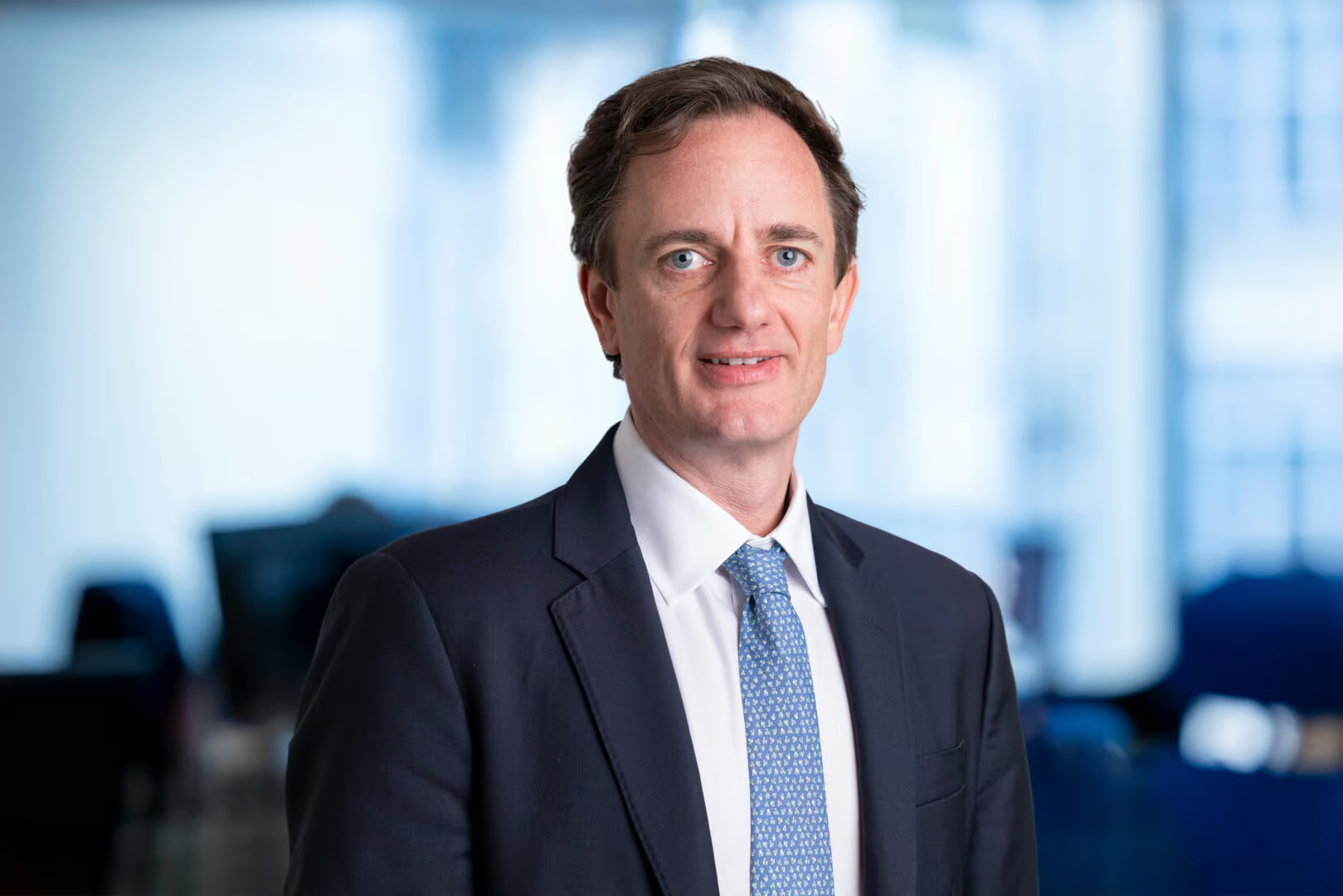
Jeremy Lacey, Partner & Development Director at Quadrant
Geopolitical unrest tends to change the mood music for UK commercial real estate. Just as the market was anticipating interest rates going down, the evolving situation in the Middle East, with the risk of imported inflation from rising energy costs, may bring interest rate rises. Meanwhile, the perception of some Gulf State cities, from Dubai to Doha, as low-risk places to live and do business has been challenged in recent weeks and may take time to recover.
Dubai particularly, until recently, had reportedly been seeing an influx of entrepreneurs, some of whom were abandoning London as their domicile. According to Henley & Partners, the UK saw a net loss of 16,500 wealthy people in 2025 in the wake of inheritance and other tax changes. But this trend could be about to reverse as high-net-worth individuals prioritise personal safety over tax efficiency.
With turmoil elsewhere, traditional global hub cities in secure developed Western markets such as London, New York and Paris, look increasingly attractive for entrepreneurs and investors alike.
At a time when tech volatility and uncertainty around AI valuations are unsettling stock markets, tangible, income-producing real assets may return to favour as a safe haven for international capital, much like they were in the years that followed the GFC.
Interest rate rises remaining higher as a result of the geopolitical backdrop are of course a risk. If we look back to their last spike in 2022, when rates rose from 0.1% to 3.5%, and the peak yet to come, overseas investment, which accounted for close to 70% of London’s commercial real estate investment activity, declined to just over half in 2023, according to CBRE. The question is will interest rates spike so sharply again and have such a dramatic effect? If the conflict de-escalates relatively quickly, the answer is likely to be no. However, whatever happens, there will still likely be a lasting impact on where global investors choose to deploy capital, with more potentially gravitating towards the security of quality London commercial real estate.
In London, a shortage of Grade A office space and rising occupier demand has also led to falling vacancy rates, while for the capital’s office market as a whole, net absorption returned to positive for the first time in six years in 2025 according to CoStar data. This further strengthens the investment case and should pique the interest of international investors seeking secure risk-adjusted returns.
Entrepreneurs, business leaders and skilled employees who may have been looking to move overseas until recently, may now be thinking again too. And while they might not get the weather or the tax benefits, they should remember the ability cities such as London have to reinvent themselves, attracting the best people and businesses in the process.
In London’s case for example, the City and Canary Wharf look very different to how they did a decade ago. Entirely new business destinations in Battersea and Nine Elms and King’s Cross have also emerged. Spurred by Battersea Power Station’s redevelopment, ever more businesses are now joining the clustering effect in the area with Foster + Partners, Penguin Random House and of course Apple, with its European HQ that is on a similar scale to its Silicon Valley offices, calling the area home. Thousands of Apple’s employees descend on the area every day, bringing ideas and innovation with them.
Developments such as OSMO, our 166,000 sq ft contemporary office building in Battersea, are contributing to this thriving new London business destination. The leases we’ve signed this year with O2 Daisy and flexible workspace provider Industrious, alongside wider enquiries we’re seeing from a breadth of occupiers, show how far the area has come. Net-zero in operation and BREEAM Outstanding, OSMO reflects how occupiers’ expectations of workspace, amenity and sustainability have changed in recent years.
In an increasingly volatile world, capital, talent and ambition will seek out places that offer depth, resilience and the ability to absorb shocks. London has never been the cheapest city to live or do business in, but history shows it remains one of the most adaptable. If geopolitical unrest prompts investors and entrepreneurs to reassess what “safe haven” really means, the combination of innovation and security London offers are likely to be to its benefit, especially in the current climate. Those able to deliver the modern sustainable workspace in London’s exciting business destinations look set to be rewarded, as entrepreneurs and innovators continue to look to the city as they always have.